Pr Dr Annie Zavagno

Welcome

Astrophysics banner image

I am a full professor at Aix Marseille Université (AMU) and a Senior Member of the Institut Universitaire de France. I conduct my research at the Laboratoire d'Astrophysique de Marseille (LAM), where I am a member of the GECO research team.

My research concerns the formation and impact of high-mass stars. I am interested in how these stars affect their surroundings and potentially trigger the formation of a new generation of stars. I study these processes using multi-wavelength and multi-scale observations from both ground-based and space telescopes, with expertise in the infrared and millimeter domains.

My current research projects focus on the small (milliparsec) to intermediate-scale (parsec) impact of high-mass stars on their surroundings.

Program Presentation

Les étoiles massives ont un impact majeur sur leur environnement et contrôlent ainsi l’évolution des galaxies. Pourtant les mécanismes qui conduisent à la formation de ces étoiles sont encore débattus. Des sondages récents de notre Galaxie, en imagerie et en spectroscopie, révolutionnent notre vision de ce phénomène. Pour la première fois nous pouvons suivre leur cycle complet de formation. A partir d’une approche multi longueur d’onde et multi échelle, j’étudie ce cycle en incluant les effets de rétroaction de ces étoiles sur leur environnement, effet dont nous venons de démontrer le rôle central de déclencheur pour la formation stellaire à venir. Le but de ce projet est d’obtenir une estimation précise du taux de formation stellaire, paramètre-clé des modèles d’évolution des galaxies.

About Me

Dr Annie Zavagno

Full professor, Laboratoire d’Astrophysique de Marseille (LAM), Aix Marseille Université (AMU), France.


Senior member of the Institut Universitaire de France (2017 – 2022). Position to promote excellence in academic research.


Senior member of the Institut Universitaire de France (2022 – 2027).

Education

  • 2002: “Habilitation à Diriger des Recherches”, Université de Provence, Marseille, France.
  • 1993: PhD, Astrophysics, Université Paris Diderot (Paris 7), France.
  • 1989: Master, Astrophysics, Université Paris 7 & Observatoire de Paris-Meudon, France.

Fellowships and Awards

  • 2008 – Present: Awarded Prime d’Excellence Scientifique.
  • 2018: Among the 3 finalists of Grand Prix du Jury de la Recherche en Provence, France.
  • 1996 – 1997: Fellowship from the French Academy of Science.
  • 1994 – 1996: ESA External Fellowship, IFSI-CNR, Rome, Italy.

Memberships of Scientific Societies

  • 2009: Member, Research Network “Herschel Specialist Astronomical Group in Star Formation”.
  • 2009: Member, Research Network “Herschel Specialist Astronomical Group in Interstellar Dust”.
  • 2000: Member of the Société Française des Spécialistes en Astronomie (SF2A).
  • 2000: Member of the International Astronomical Union (IAU).

Research

Formation stellaire induite

La formation stellaire induite - Académie des sciences (2014)

General presentation on high-mass stars and star formation (in french).

Learn more...
Star Formation

HII regions and High mass star formation

High mass stars form ionized (HII) regions. These regions expand in the interstellar medium and this expansion impacts on the surrounding. This feedback is expected to be both constructive (favoring the formation of a new generation of stars) and destructive (destruction of the surrounding material).

I am interested in the role of this expansion on the properties of the star formation.

Filaments

HII regions and filaments

Filaments are ubiquitous in the interstellar medium. They host star formation. I am interested in the role of HII regions in the formation of filaments.

BigSF

Big Data and Machine Learning

A wealth of existing data is available in our Galaxy at all wavelengths. This allows to use these data to learn properties of the sources using Machine Learning (ML) algorithms. We just started a study to see how ML can be used to describe the Galactic Star Formation.

Presentation of BigSF Project

The research project entitled "Star formation with big data and machine learning (BigSF)" proposes to use the very large masses of data available on our Galaxy in order to build, through numerical learning methods, a new empirical model of stellar formation.

Galaxy Distance

Distances in the Galaxy

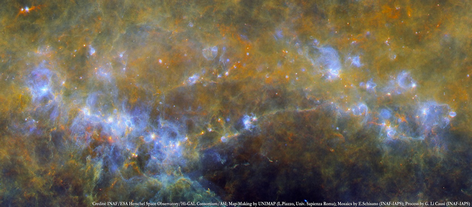
The Herschel survey of the Galactic Plane has revealed the presence of about 150,000 sources. We have been engaged in a big effort to determine the distances of these sources using available molecular data. The results are presented in a paper (Mège et al. 2020). This opens an important field for the study of star formation in the Galaxy.

Major Collaborations

  • Dupé, Schisano, Molinari, Brescia et al. Machine Learning for astrophysics.
  • André, Schuller, Peretto et al. ArTéMiS view of high mass stars forming regions.
  • Motte, Zavagno, Bontemps et al. The Herschel Survey of OB Young Stars (HOBYS), France
  • Molinari et al. The Herschel Infrared Galactic Plane survey Hi-GAL, INAF, Italy.

Teaching & Supervision

Supervision

Supervision of graduate students and postdoctoral fellows (2002 - Present)

  • 9 Postdocs
  • 8 PhD students
  • 8 Master Students (4 to 6 months internships, including 3 engineers terminal internships)
  • 6 Software engineers

Teaching Activities

  • 1997 - 2020: L1 – Classical mechanics, AMU, France. With innovative pedagogy (inverted classes)
  • Since 2018: L1 – Mathematics for Physics, AMU, France. With innovative pedagogy (inverted classes)
  • 1997 – 2002 & 2024 - Present: L1 – Mathematics for Physics, AMU, France. With innovative pedagogy (inverted classes)
  • 2014 – 2016 & 2020 - Present: Master 1 – Astrophysics, AMU, France
  • 2008 – 2016: Master 2 – Astrophysics, AMU, France
  • 2019 - 2022: Master of Physics (M1 & M2 students) : Scientific Watch: Science Projects on Star Formation, Galactic Filaments, etc.

Publications

ads logo no background

Full Publication List

For a complete and up-to-date list of my work and metrics, please visit my ORCID profile.

List of scientific productions on NASA ADS Website ADS Metrics

Most Relevant Publications

Stellar feedback in the star formation-gas density relation: Comparison between simulations and observations
Suin, Zavagno, Colleman, Hennebelle, Verliat, Russeil 2024, A&A, 682, A76

Role of early radiative feedback in setting the star formation laws.

Bibliographic information on ADS

Supervised machine learning on Galactic filaments. Revealing the filamentary structure of the Galactic interstellar medium
Zavagno, Dupé, Bensaid et al. 2023, A&A, 669, A120

Use of machine learning to study the filamentary structure of the Galactic interstellar medium.

Bibliographic information on ADS

H II regions and high-mass starless clump candidates II. Fragmentation and induced star formation at 0.025 pc scale
Zhang, Zavagno, Lopez-Sepulcre et al. 2021, A&A, 646, A25

Cores fragmentation in high mass star formation as a function of the environment. ALMA data, high resolution, probed spatial scale 0.025 pc (5600 AU).

Bibliographic information on ADS

Spatial distribution of star formation related to ionized regions throughout the inner Galactic plane
Zavagno, Russeil, Motte et al. 2010, A&A, 518, L81

First Herschel view on star formation around RCW 120. High mediatic impact.

Bibliographic information on ADS | ESA Press Release

Metrics Summary

  • Publications: 273 papers (159 A-ranked)
  • h-index: 61 (ADS)
  • Citations: > 15,000 (ADS)

Outreach

Dissemination of Scientific Culture

Press & Media